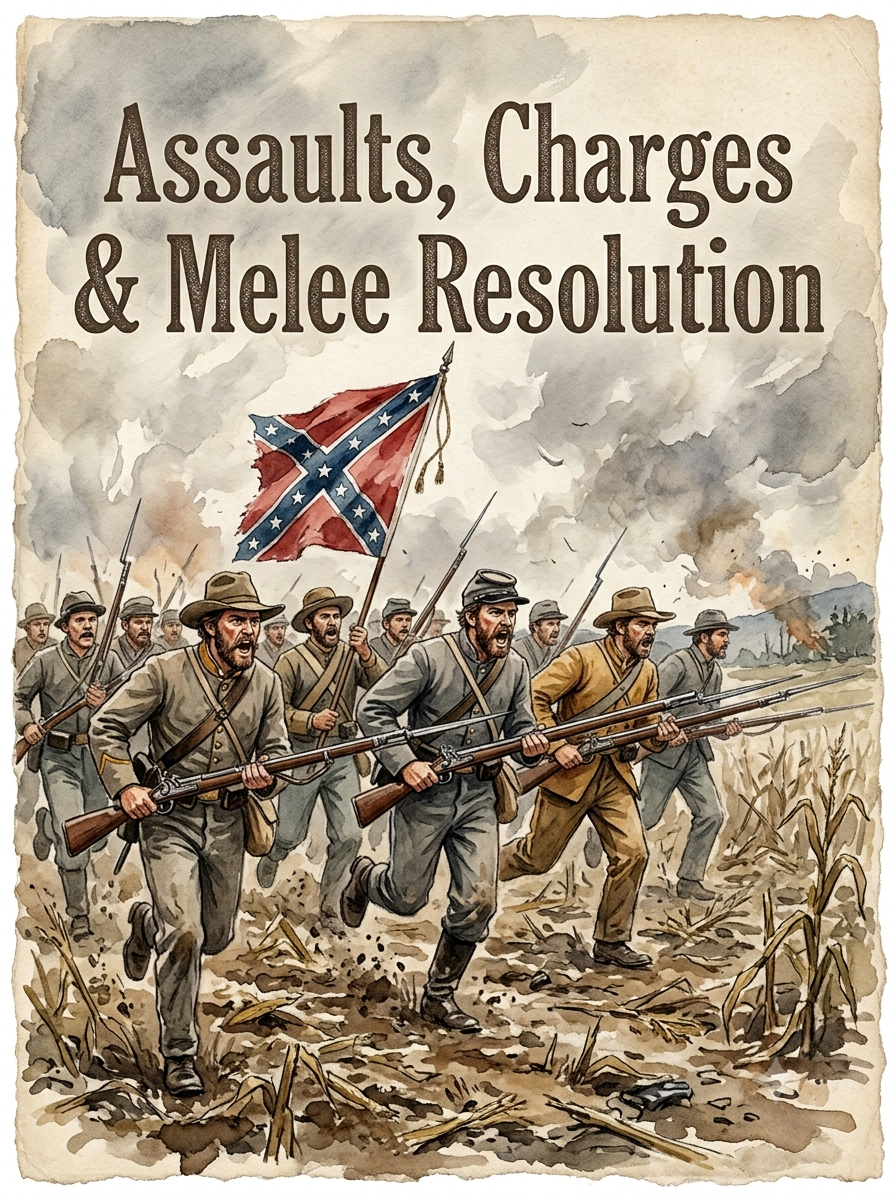
06. ASSAULTS, CHARGES, OPPOSING SHOCK & MELEE RESOLUTION
"Up, men, and to your posts! Don't forget today that you are from old Virginia."
— Major General George Pickett, 1863
1.0 Assault Initiation & Charge Declarations
- [RULE-06-1.1] The Decisive Shock Phase: While ranged combat inflicts attritional attrition, close-quarters assaults and bayonet charges represent the decisive shock actions of American Civil War battlefields. Assaults are initiated during Phase 2: Active Maneuver & Assault Phase and resolved in Phase 4: Assault & Melee Resolution Phase .
- [RULE-06-1.2] The Command Requirement (Staff Pip Expenditure):
- Declaring an assault is an extraordinary exertion of command. Every infantry or cavalry regiment declaring an assault must spend 1 Staff Pip from its parent Brigadier’s command pool .
- If a Brigadier has zero available Staff Pips, subordinate regiments cannot declare charges and must remain in stationary firing or standard maneuver postures.
- Regiments belonging to a Hesitant or Broken brigade cannot declare assaults under any circumstances .
-
[RULE-06-1.3] Charge Eligibility Criteria: An infantry or cavalry unit is eligible to declare an assault if it meets all of the following conditions:
-
It is deployed in Line of Battle or Assault Column . Units in Road Column cannot assault.
-
It is not Disordered at the moment of declaration.
-
It is in a Fresh or Worn health state. A unit in a Spent health state (<35% stands remaining) cannot initiate a charge unless led directly by an attached Brigadier .
-
The intended target is within the charging unit's forward 45^\circ arc of vision and within Double-Quick Charge Range (9.0 inches for infantry, 12.0 inches for mounted cavalry).
-
[RULE-06-1.4] The Charge Vector & Alignment:
- The charging unit designates a single enemy target and moves at accelerated Double-Quick speed (9.0") along a straight line toward the target's front or exposed flank.
- No complex wheeling or formation changes are permitted during a charge; the charging unit may make a single initial pivot of up to 30^\circ at the start of its move to align its center with the target.
- [RULE-06-1.5] Terrain Restrictions on Assaults:
- Streams & Creeks: Crossing a minor stream (e.g., Heron’s Run) immediately halts a charge; the charging unit must stop in the waterbed Disordered . Charges may only cross waterways via stone bridges or marked shallow fords.
- Dense Woods & Scrub: Reduces maximum charge speed to 4.0 inches and imposes an immediate Disorder Marker upon contact .
- Ploughed Fields & Mud: Deducts -2.0 inches from the maximum charge distance.
2.0 The Approach & Reaction Trigger Window B (The 4.0-Inch Line)
- [RULE-06-2.1] The 4.0-Inch Interruption Line:
When a charging regiment advances to within 4.0 inches of the target unit's front edge, the charging unit's physical movement is temporarily suspended. The game enters Reaction Trigger Window B .
-
[RULE-06-2.2] Order of Defensive Reactions: The defending player assesses their tactical options and declares one of three reactive choices:
-
Reaction 1: Closing Defensive Volley : The defender delivers a point-blank volley at the closing attackers (Free).
-
Reaction 4: Refuse the Flank : If the charge targets an exposed flank, the defender may spend 1 Reserved Pip (or pass a 4+ check) to wheel outer stands 45^\circ to meet the charge frontally.
-
Reaction 5: Counter-Charge : Eligible defending units (Rebel Yell units, Veterans, or Cavalry) spend 1 Reserved Pip to surge 2.0"–3.0" forward to clash in open ground.
-
[RULE-06-2.3] Resolving the Closing Defensive Volley:
- If the defender chooses to fire a Closing Volley, roll 1D6 per defending stand (or 2D6 per artillery section) using Short Range (0–6") target numbers :
- Smoothbore Musket (Buck & Ball): Hits on 3+.
- Rifled Musket: Hits on 4+.
- 12-pdr Napoleon Canister: Hits on 2+ (Triggers Shock Save on target).
- 3-inch / 10-pdr Rifle Canister: Hits on 3+.
- Apply cover saves (if charging through light scrub); remove casualty stands (2 hits = 1 stand loss). Any natural 6 rolled by the defender inflicts an immediate Disorder Marker on the charging unit .
- [RULE-06-2.4] The Pre-Contact Discipline Check:
- Trigger: If the Closing Volley inflicts 1 or more physical stand losses OR places a Disorder Marker on the charging unit, the attackers' momentum is severely disrupted.
- The charging unit must immediately roll a Discipline Check on 1D6:
- Veteran / Elite Quality: Passes on 3+.
- Regular Quality: Passes on 4+.
- Green / Conscript Quality: Passes on 5+.
- [RULE-06-2.5] Consequences of the Discipline Check:
- Pass: The charging regiment closes ranks over fallen comrades, steadies its battle flags, and surges across the remaining 4.0" into physical base-to-base contact. Proceed to Phase 4 Melee.
- Fail: The charge stalls completely. The charging unit immediately halts 2.0 inches away from the defender, receives a Disorder Marker (if not already disordered), and cannot move or attack further this turn.
3.0 Physical Contact & The Opposed Melee Roll (Phase 4)
- [RULE-06-3.1] Base Alignment & Contact Geometry:
- When a charging unit successfully reaches the defender, place the front bases of the attacker in flush, physical contact with the defender’s front or flank bases.
- Frontal Alignment: If the charge hits the front edge, the attacker aligns front-edge to front-edge.
- Flank Alignment: If the charge hits the flank, the attacker's front edge contacts the target's side stands at a 90^\circ angle.
- [RULE-06-3.2] The Opposed Melee Formula:
Melee in this ruleset is not a prolonged, attrition-heavy slugfest; it is resolved in a single, decisive opposed roll during Phase 4: Assault & Melee Resolution Phase :
\mathbf{Shock Score} = 1D6 + Engaged Stands + Tactical Modifiers
- Both players roll a single 1D6 simultaneously, add the number of stands directly engaged, and apply all relevant tactical modifiers from the Master Shock Table below.
Master Tactical Shock Modifiers Catalog
- [RULE-06-3.3] Master Shock Modifiers Matrix:
| Tactical Condition |
Modifier Value |
Applicable Side |
Reference Rule |
| Fresh Unit Health (>75% starting stands remaining) |
+1 |
Attacker or Defender |
|
| Spent Unit Health (<35% starting stands remaining) |
-1 |
Attacker or Defender |
|
| Charging Momentum (Moved >= 3.0" across open ground) |
+1 |
Attacker Only |
|
| Assault Column Formation |
+1 |
Attacker Only |
|
| Confederate Rebel Yell Trait |
+1 |
Attacker (or Counter-Charge) |
|
| Mounted Cavalry Shock (Charging infantry in open) |
+1 |
Cavalry Attacker Only |
|
| Defending Heavy Earthworks / Stone Wall / Sunken Road |
+2 |
Defender Only |
|
| Defending Light Cover / Split-Rail Fence / Crestline |
+1 |
Defender Only |
|
| Target Enfiladed / Flank or Rear Attack |
+2 |
Attacker Only |
|
| Unit is Disordered |
-2 |
Attacker or Defender |
|
| Brigadier General Attached Directly to Stand |
+1 |
Attacker or Defender |
|
- [RULE-06-3.4] Engaged Stand Count Calculation:
- Frontal Clashes: Count all stands in the front rank that are in direct physical base-to-base contact, plus up to 1 unengaged flanking stand on each outer wing that can provide overlapping support.
- Assault Columns: An Assault Column formed 2 stands wide counts its 2 front stands plus the 2 supporting stands immediately in the second rank (4 stands total).
- Flank Attacks: Only the defending stands directly contacted by the attacker's frontage contribute to the defender's stand count; unengaged stands facing perpendicular cannot contribute their strength.
4.0 Melee Resolution, Casualties & Aftermath
-
[RULE-06-4.1] Determining the Victor:
Compare the final modified Shock Scores of both players:
-
Higher Score: Declared the Victor.
- Lower Score: Declared the Defeated.
-
Equal Scores (Tie): The combat is a bloody deadlock .
-
[RULE-06-4.2] Tied Melee Combats (The Bloody Draw):
- If both players calculate identical final Shock Scores, both units remain locked in vicious hand-to-hand combat.
- Casualties: Both sides sustain 1 unsaved hit (place a micro-dice behind each unit's Color Stand).
- Status: Neither unit retreats; both units receive a Disorder Marker. Melee will be re-rolled during the next game turn's Melee Phase unless one unit is relieved by supporting fire.
-
[RULE-06-4.3] Consequences for the Defeated Unit:
The defeated side suffers severe physical and moral collapse:
-
Mandatory Stand Loss: The defeated unit immediately loses 1 physical stand permanently, removed directly from the table (regardless of remaining hits on micro-dice).
- Disordered Retreat: The surviving stands must immediately execute a 6.0-inch retreat directly away from the victor, maintaining their current facing or falling back in disorder.
-
Disorder Applied: The retreating unit receives a Disorder Marker.
-
The Double Disorder Clause: If the defeated unit was already Disordered prior to rolling the Opposed Melee Roll (e.g., disordered by previous musketry or by the closing volley), it suffers the standard melee penalty (1 Stand loss + retreat 6.0") and triggers the [RULE-07-3.4] Double Disorder Rule, immediately taking an additional 1 Micro-Hit instead of a second Disorder marker.
-
[RULE-06-4.4] Consequences for the Victor (Consolidation & Reform):
- The victor sustains zero mandatory casualties from the melee roll and successfully holds the contested position.
- Free Consolidation Move: The victor may immediately execute a free 2.0-inch Consolidation Move:
- Advance 2.0" to occupy the vacated enemy earthworks, stone wall, or ridge.
- Pivot up to 45^\circ to face an exposed flank threat.
- Dress ranks and re-form a neat battle line.
- [RULE-06-4.5] Breakthrough & Sweeping Advances:
- Trigger: If a Fresh Attacker wins an assault with a margin of victory of +4 points or greater, and the defending unit was completely Routed/Destroyed, the attacker has achieved a Tactical Breakthrough.
- The Sweeping Advance: The victorious regiment may spend 1 additional Staff Pip from its Brigadier to execute an immediate 4.0-inch Sweeping Advance in a straight line forward. If this advance contacts a second enemy unit or artillery battery, resolve a second melee immediately with the defender counting as Disordered.
5.0 Assaulting Artillery Batteries & Heavy Fortifications
- [RULE-06-5.1] Overrunning Artillery Batteries:
- When an infantry or cavalry assault successfully closes into base-to-base contact with an unlimbered artillery battery, the artillery gunners fight hand-to-hand with rammers and sidearms.
- Artillery Melee Profile: An artillery battery section rolls 1D6 and adds +1 stand to its shock score. It receives no weapon bonuses in hand-to-hand combat.
- Battery Overrun & Capture: If the artillery battery is defeated in melee, the battery is Overrun and Captured. All gun models and crew are permanently removed from play. The victorious infantry unit occupies the gun positions.
- [RULE-06-5.2] Storming Heavy Earthworks, Stone Walls & Sunken Roads:
- Assaulting troops attempting to storm heavy stone walls , sunken roads , or engineered breastworks must overcome significant defensive advantages:
- Defenders gain +2 to their Opposed Melee Roll.
- Attackers lose all Charging Momentum (+1) bonuses upon contacting the obstacle.
- Repulse from the Works: If the attacker fails to beat the defender's score, the attacker is repulsed, takes 1 stand loss, and retreats 6.0" Disordered into the open field.
6.0 Master Melee Modifiers Reference Matrix
| Modifier Name |
Point Value |
Applied To |
Mandatory Condition |
Reference |
| Fresh Unit |
+1 |
Either |
>75% original stands remaining in unit |
|
| Spent Unit |
-1 |
Either |
<35% original stands remaining in unit |
|
| Charging Momentum |
+1 |
Attacker |
Advanced >= 3.0" across open ground |
|
| Assault Column |
+1 |
Attacker |
Formed 2 stands wide x 2+ deep |
|
| Rebel Yell |
+1 |
Confederate |
Unit possesses Rebel Yell trait |
|
| Cavalry Shock |
+1 |
Cavalry |
Mounted charge against infantry in open |
|
| Heavy Fortifications |
+2 |
Defender |
Touching Stone Wall, Sunken Road, Works |
|
| Light Obstacle |
+1 |
Defender |
Touching Split-Rail Fence or on Crestline |
|
| Flank / Rear Contact |
+2 |
Attacker |
Contacted behind target's 90^\circ flank line |
|
| Disordered State |
-2 |
Either |
Unit possesses a Disorder Marker |
|
| Attached Brigadier |
+1 |
Either |
Brigadier attached to Color Stand |
|
Step 1: Charge Declaration & Approach
- Brigadier Garnett spends 1 Staff Pip to order the 4th Virginia (5 stands, Veteran, Fresh) to assault the 2nd Wisconsin (5 stands, Veteran, Fresh) across an open field (7.0" distance).
- The 4th Virginia advances at Double-Quick speed. Movement pauses at the 4.0-inch line for Reaction Window B.
Step 2: Closing Volley & Discipline Check
- The 2nd Wisconsin delivers a Closing Volley: 5 stands = 5D6 (Rifled Muskets hit on 4+ at Short Range).
- Rolls:
[2, 4, 1, 6, 5]. Results: 3 hits scored (including one natural 6).
- Casualties: 3 hits on open troops = 1 stand removed from the 4th Virginia (reduced to 4 stands, 1 micro-hit carried over). The natural 6 inflicts a Disorder Marker.
- Discipline Check : Sufferings losses and Disorder, the 4th Virginia rolls 1D6 for its Veteran Discipline Check (3+). Roll is a
5—Passed! The Virginians steady their ranks and close into physical base contact.
Step 3: Opposed Melee Roll
Both players roll 1D6 simultaneously and calculate their final Shock Scores:
\mathbf{4th Virginia (Attacker):} \quad 1D6 Roll: 5
Score = 5 (Die) + 4 (Stands) + 1 (Fresh) + 1 (Momentum) + 1 (Rebel Yell) + 1 (Brigadier) - 2 (Disorder) = \mathbf{11}
\mathbf{2nd Wisconsin (Defender):} \quad 1D6 Roll: 3
Score = 3 (Die) + 5 (Stands) + 1 (Fresh) = \mathbf{9}
Step 4: Melee Aftermath
- Victor: 4th Virginia wins (11 to 9). The Virginians hold the ground and consolidate 2.0" forward.
- Defeated: 2nd Wisconsin loses 1 stand (reduced to 4 stands), receives a Disorder Marker, and retreats 6.0 inches to the rear.
- Leader Check : Because the 4th Virginia took a stand loss during the charge with an attached Brigadier, Garnett rolls on the Leader Loss table: rolls a
4—Unhurt!
Step 1: Charge Declaration & Closing Volley
- The 14th Brooklyn (6 stands in Assault Column) spends 1 Staff Pip to assault the 7th North Carolina deployed behind a heavy stone wall.
- At 4.0", the North Carolinians deliver a Closing Volley (4D6, Rifled Muskets hit on 4+).
- Rolls:
[1, 3, 5, 2]. Result: 1 hit scored.
- The 14th Brooklyn takes 1 hit (tracked on micro-dice; no stand lost, no natural 6). No discipline check is required; the Brooklyn assault column hits the stone wall!
Step 2: Opposed Melee Roll
- 14th Brooklyn (Attacker):
- Stands Engaged: 4 stands (2 front rank + 2 second rank column support).
- Roll:
4.
- Modifiers: +1 (Fresh), +1 (Assault Column). (Note: Charging momentum is lost against the heavy stone wall, ).
- Attacker Total Score: 4 + 4 + 1 + 1 = \mathbf{10}.
- 7th North Carolina (Defender):
- Stands Engaged: 4 stands.
- Roll:
4.
- Modifiers: +1 (Fresh), +2 (Defending Stone Wall, ).
- Defender Total Score: 4 + 4 + 1 + 2 = \mathbf{11}.
Step 3: Melee Aftermath
- Victor: 7th North Carolina holds the stone wall (11 to 10).
- Defeated: 14th Brooklyn is repulsed from the wall. It loses 1 physical stand (reduced to 5 stands), receives a Disorder Marker, and retreats 6.0 inches back into the open meadow.
8.0 Designer Notes & Historical Commentary
The Psychology of the Civil War Bayonet Charge
Medical statistics from the American Civil War reveal a striking fact: fewer than 1% of all battlefield wounds were caused by bayonets or sabers.
Historical studies by military historians (such as Brent Nosworthy and Paddy Griffith) demonstrated that Civil War charges were almost never physical "fencing matches." Instead, an assault was a contest of moral cohesion and psychological shock:
1. The attackers advanced under heavy fire, screaming (the Rebel Yell) to bolster their courage and terrify the defenders.
2. The defenders waited until the chargers were within 30 to 50 yards (1.0"–2.0" ground scale) to unleash a point-blank closing volley.
3. If the volley shattered the attackers' alignment, the charge stalled and melted away in disorder. But if the attackers absorbed the fire and kept coming with bayonets leveled, the defenders almost invariably broke and ran before physical contact occurred.
The mechanics in this chapter directly replicate this historical dynamic:
* The Closing Defensive Volley at 4.0 Inches determines whether the attackers have the discipline to press home the assault.
* The Single Opposed Melee Roll models the immediate moral climax: one side holds its ground with a cheer, while the other shatters, drops a casualty stand, and flees 6.0" to the rear in disorder.
* By eliminating multi-round, grinding melee rounds, the game stays fast, decisive, and historically authentic.