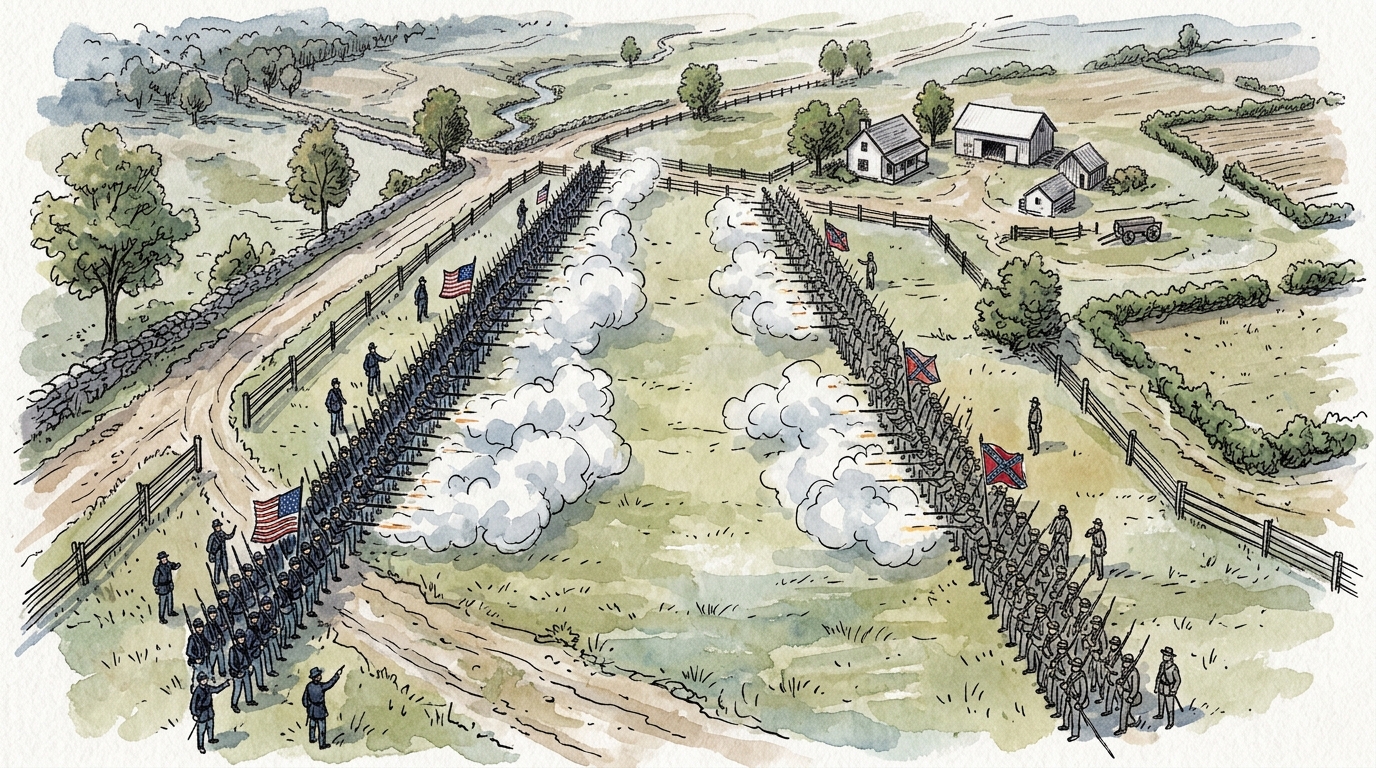
"It was not a battle; it was a murder." — Major General Daniel Harvey Hill, 1862
[RULE-05-1.2] Firing Eligibility Criteria: A unit is eligible to execute ranged fire in Phase 3 if it meets all of the following conditions:
Did Not Move (Hold Position): It did not execute an Advance or Double-Time move in Phase 2. To fire, a unit must have chosen the "Hold Position" order. (Exception: Units that only performed a Pivot/Wheel or Formation Change may fire, but suffer a -1 to-hit penalty).
It is not currently in physical base-to-base contact with an enemy unit in Melee.
It is not deployed in Road / March Column .
It has a valid, unobstructed Line of Sight to an enemy unit within its forward 45^\circ arc of fire .
It did not fire as an Opportunity Fire reaction during the opponent's preceding turn , unless it has since moved out of its smoke.
| Weapon Classification | Point-Blank Range (0" - 4.0") | Medium Range (4.1" - 8.0") | Long Range (8.1" - 16.0") | Tactical Characteristics & Historical Notes |
|---|---|---|---|---|
| Smoothbore Musket (.69 Cal / Buck & Ball) | 4+ (Roll 2 Dice per stand) |
4+ (Roll 1 Die per stand) |
— (Out of Range) |
Buck & Ball: Devastating shotgun-like effect at close range. Incapable of accurate fire beyond 200 yards. |
| Rifled Musket (Springfield / Enfield .58/.577) | 4+ (Roll 1 Die per stand) |
4+ (Roll 1 Die per stand) |
5+ (Roll 1 Die per stand) |
Universal Standard: Consistent, reliable firepower across all tactical distances up to 400 yards. |
| Single-Shot Breechloader (Sharps) | 4+ (Roll 1 Die per stand) |
4+ (Roll 1 Die per stand) |
4+ (Roll 1 Die per stand) |
Prone Reload: No long-range penalty. When deployed as Skirmishers or Dismounted Cavalry, they count as being in Light Cover (5+) even in open ground because they can reload while prone. |
| Double-Barreled Shotgun | 4+ (Roll 3 Dice per stand) |
— (Out of Range) |
— (Out of Range) |
Devastating Point-Blank: Used by partisan and militia cavalry. Extremely lethal up close but useless beyond 200 yards. |
| Whitworth Sniper Rifle | 4+ (Roll 1 Die per stand) |
4+ (Roll 1 Die per stand) |
4+ (Roll 1 Die per stand) |
Telescopic Sight: Range extends to an unprecedented 24.0". Ignores Light Cover saves. Only equipped by elite sharpshooter stands. |
| Magazine Repeater (Spencer / Henry) | 4+ (Roll 3 Dice per stand) |
5+ (Roll 1 Die per stand) |
— (Out of Range) |
Rapid Fire & Prone Reload: Devastating up close. Like Breechloaders, Skirmishers and Dismounted Cav armed with Repeaters gain Light Cover (5+) in open ground. |
| Ordnance Type & Caliber | Double Canister (0" - 4.0") | Standard Canister (4.1" - 10.0") | Medium/Long (Shell/Solid) (>10.0") | Tactical Characteristics & Battery Role |
|---|---|---|---|---|
| 12-pdr Napoleon (Smoothbore) | 2+ (Roll 3 Dice per stand) | 3+ (Roll 2 Dice per stand) | 4+ (up to 30") | Canister Monster: Devastating defensive fire. |
| 3-inch Ordnance Rifle (Wrought Iron) | 3+ (Roll 3 Dice per stand) | 4+ (Roll 2 Dice per stand) | 4+ (up to 36") | Precision Sniper: Exceptional long-range counter-battery and plunging hill fire. |
| 10-pdr / 20-pdr Parrott Rifle | 3+ (Roll 3 Dice per stand) | 4+ (Roll 2 Dice per stand) | 4+ (up to 36") | Heavy Rifled Shell: High penetration; +1 to hit stone buildings and fortifications. |
| 12-pdr / 24-pdr Field Howitzer | 2+ (Roll 3 Dice per stand) | 3+ (Roll 2 Dice per stand) | 5+ (up to 24") | Lobbed Spherical Case: Ignores light cover saves when firing shell over low ridges/fences. |
[RULE-05-2.4] Depressed Muzzles & Double Canister Carnage: When an artillery battery fires at an enemy within Point-Blank Range (0" - 4.0"), it is assumed the gunners are depressing their muzzles to bounce the shot off the ground and desperately loading double canisters of iron balls. In addition to the bonus dice, no cover saves are permitted against Double Canister hits. Furthermore, the target regiment suffers a -1 penalty to its resulting Discipline Check for every casualty sustained from this volley, overriding standard morale modifiers and representing the terrifying, regiment-shredding nature of this fire.
[RULE-05-2.5] Artillery vs. Deep Formations: A regiment deployed in a deep Assault Column presents a massive vulnerability to artillery fire (bowling-alley effect). An Assault Column suffers a -1 penalty to its Cover Saves against all incoming Artillery fire (Canister, Shell, and Solid Shot).
[RULE-05-3.1] The Cover Save Step: For every hit scored by the firing unit, the defending player rolls 1D6 Cover Save. Unsaved hits inflict physical casualties and attrition.
The Shock Trigger (Range Dependent): * At Short Range (0–6"): A single natural 6 rolled to hit by the firing player acts as a Shock Trigger. * At Medium/Long Range (>6"): The fire is more dispersed. It requires TWO natural 6s rolled in the same volley to act as a Shock Trigger.
1D6 against their rating: Veteran 3+, Regular 4+, Green 5+). If they fail, they receive a Disorder Marker.Crossfire (Fired on by multiple enemy units this phase): -1
[RULE-05-4.3] Resolution Timing & Multiple 6s: The Discipline Save is made immediately, regardless of cover saves against casualties. Rolling extra 6s beyond the required trigger does not force multiple saves; however, every 6 still counts as a valid hit for casualty purposes.
[RULE-05-4.4] Tactical Effects of Being Disordered: A unit with a Disorder Marker suffers severe tactical restrictions:
Movement: Cannot Double-Time; movement speed is reduced by -2.0 inches.
It applies to the unit that generated the smoke attempting to fire out, as well as any other friendly or enemy unit attempting to fire into or through that smoke marker. Gunsmoke never restricts or penalizes movement, it only obscures vision.
Advancing Through Smoke (Instant): If the regiment executes a forward movement during Phase 2, it steps out of its own smoke bank; remove the Smoke Marker immediately.
Holding Fire (Turn Clean-up): If a smoked unit chooses to hold its fire for an entire active phase (letting the air clear and barrels cool), the Smoke Marker is removed during Phase 5: Clean-up .
Windy Weather Condition: If the scenario designates a "Brisk Wind" weather condition, all smoke markers on the table are removed automatically at the end of every active player's turn.
[RULE-05-5.5] Multi-Regiment Smoke Walls: If three or more adjacent regiments in the same brigade fire from stationary positions, their individual smoke markers merge to form a continuous Smoke Wall. Line of sight through a Smoke Wall is completely blocked beyond 8.0 inches, preventing long-range artillery bombardment from targeting units behind the line.
The friendly unit must be at least 4.0 inches away from the targeted enemy unit.
Canister Safety Rule: Canister (0–6") can never be fired overhead across friendly troops.
| Tactical Condition | To-Hit Modifier | Save Modifier | Reference Rule |
|---|---|---|---|
| Firer is Disordered | -1 To-Hit | — | |
| Firer Targeting Enfiladed / Flank Arc | +1 To-Hit | Denies Fence Save | |
| Firing Through / Out of Smoke (>6") | -1 To-Hit | — | |
| Firing Through Friendly Skirmish Screen | -1 To-Hit | — | |
| Target in Light Cover (Woods, Fences, Crops) | — | Saves on 5+ | |
| Target in Heavy Cover (Stone Walls, Earthworks) | — | Saves on 4+ | |
| Target in Road Column Formation | — | -2 to Saves | |
| Concentrated Artillery Battery Barrage | — | -1 to Saves | |
| Target in Skirmish Order (Dispersed) | — | Saves on 5+ |
The Lethality of Civil War Musketry & The "Smoke Blind"
Popular Civil War history often overstates the lethality of the rifled musket, imagining infantry lines dropping entire brigades at 400 yards. In actual battle, combat studies from Antietam, Gettysburg, and Chickamauga show that the vast majority of decisive firefights took place at 50-120 yards (2.0"–5.0" tabletop scale).
Why? Because after the first two regimental volleys, the battlefield became an impenetrable wall of dense, blinding black powder smoke. Officers could not see targets 100 yards away; soldiers aimed low into the sulfur clouds, firing at muzzle flashes and red battle flags. Barrels fouled with heavy lead and carbon residue, making reloading progressively harder.
The Gunsmoke Obscuration Rule elegantly recreates this historical reality without bogging the game down in chart calculations: 1. It creates a natural firepower degradation: standing in one place and firing turn after turn degrades your accuracy (-1 to-hit beyond 6"). 2. It encourages aggressive tactical movement: to deliver a truly devastating volley, an attacking commander must advance through the smoke bank to reach Short Range (0–6"), where the smoke penalty disappears and Smoothbore Buck & Ball hits on a deadly 3+. 3. It gives meaning to Artillery Positioning: placing rifled batteries on elevated ridges allows them to see over the smoke banks of the valley, providing accurate plunging fire when infantry lines are blinded below.