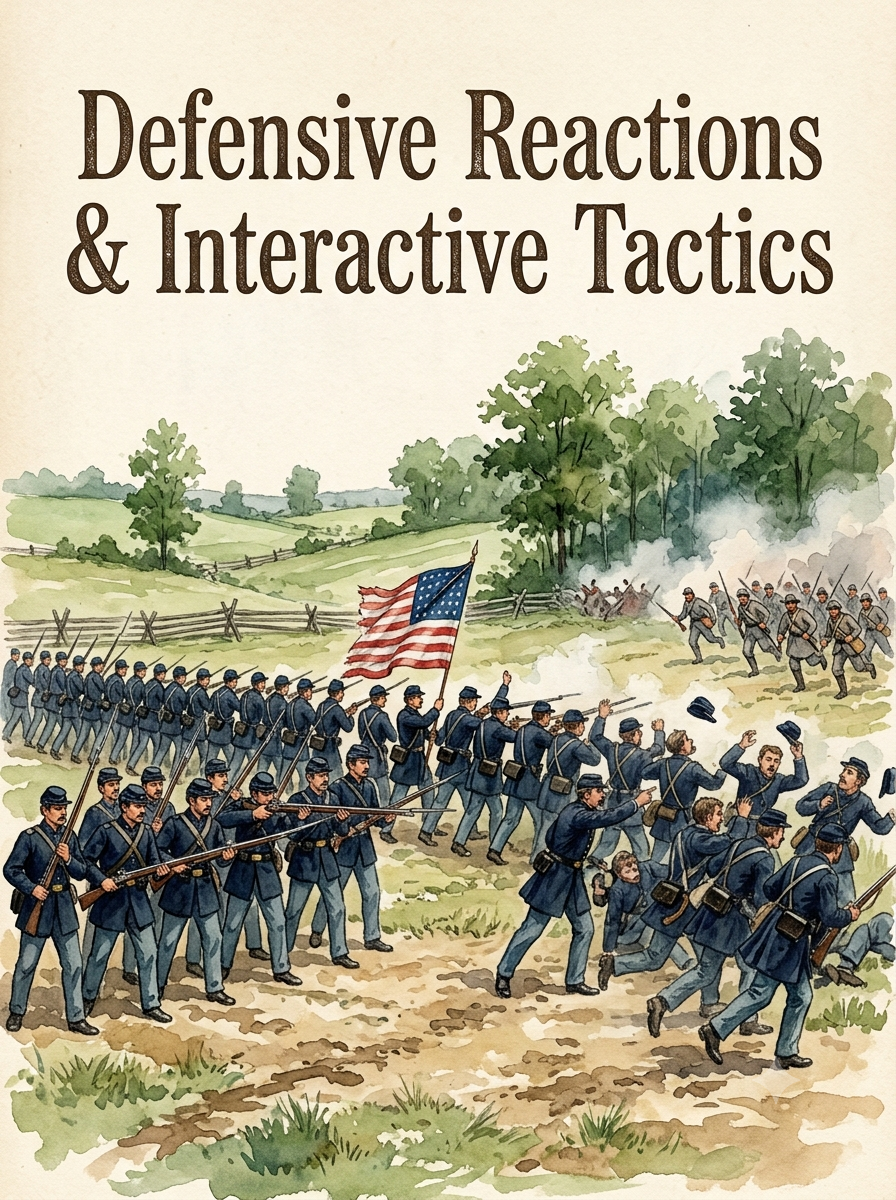
"It is well that war is so terrible, or we should grow too fond of it." — General Robert E. Lee, 1862
| Reaction Name | Primary Trigger | Staff Pip Cost | Eligible Units | Mechanical & Combat Effect |
|---|---|---|---|---|
| 1. Closing Volley | Enemy charges within 4.0" | Free | Formed unsmoked, undisordered units | Point-blank volley; 1+ hit or Nat 6 forces charger Discipline Check (4+) or charge stalls 2.0" away Disordered. |
| 2. Opportunity Fire | Enemy crosses front arc within 8.0" | Free | Unengaged, unsmoked formed lines | Pauses enemy move; delivers volley; places Smoke Marker on firer; counts as fired for next turn. |
| 3. Skirmish Evade | Formed enemy closes within 6.0" | Free | Detached skirmishers / cavalry screens | Screen makes immediate 4"–6" escape move through friendly lines without disordering parent unit. |
| 4. Refuse Flank | Enemy enters flank zone (45^\circ–90^\circ) | 1 Reserved Pip (or 4+ Check) | Formed infantry lines in Line of Battle | Outer 1–2 stands wheel 45^\circ to face threat; cancels enemy +1 enfilade to-hit and +2 flank melee bonuses. |
| 5. Counter-Charge | Enemy declares charge in open ground | 1 Reserved Pip | Rebel Yell units, Veterans, or Cavalry | Unit surges 2"–3" forward to meet attacker; cancels attacker momentum; applies +1 shock trait. |
Assault Declaration: The 14th Brooklyn declares a charge against the 5th Virginia across an open pasture (8.0" separation). The Union player spends 1 Staff Pip and moves the Brooklyn regiment forward.
Interruption at 4.0 Inches : At the 4.0" mark, movement halts. The Confederate player declares Reaction 1: Closing Defensive Volley.
Volley Execution :
The 5th Virginia fields 5 stands armed with Smoothbore Muskets (Buck & Ball). At Short Range (0–6"), they hit on 3+.
[3, 3, 5, 2, 6].Suppression: The natural 6 inflicts an immediate Disorder Marker.
Discipline Check :
Sufferings stand losses and Disorder forces the 14th Brooklyn to make an immediate Discipline Check (4+ for Regulars).
The Union player rolls a 2—Failed!
Aftermath : The charge stalls. The 14th Brooklyn halts 2.0" away from the Virginia line, reduced to 3 stands, Disordered. The 5th Virginia receives a Smoke Marker. No melee occurs.
Why These Five Reactions?
The historical record of the American Civil War is replete with moments where a battle turned on split-second regimental reactions rather than high-level generalship: * The Closing Volley: At the Battle of Franklin (1864) and the Peach Orchard at Shiloh (1862), advancing assault waves were repeatedly shattered and halted within 30 paces by disciplined, point-blank volleys delivered by steady defenders waiting behind breastworks. * Refusing the Flank: Joshua Lawrence Chamberlain’s famous maneuver with the 20th Maine at Little Round Top—wheeling his left-flank company back at a right angle—is the quintessential example of Refusing the Flank under pressure. * The Counter-Charge: Confederate doctrine frequently emphasized meeting an oncoming Union advance with a sudden, screaming counter-charge into open ground, catching the Federal line disordered as it crossed fences or ditches.
By codifying these historical behaviors into five clear reaction triggers governed by a simple resource economy (Reserved Staff Pips), the game achieves maximum tactical realism and high player engagement without degenerating into chaotic, off-turn rule arguments.