"I can make a brigadier general in five minutes, but it is not easy to replace a good horse." — President Abraham Lincoln, 1862
| Leadership Profile | Description & Historical Examples | Staff Pip Generation Formula |
|---|---|---|
| Aggressive / Brilliant | Highly proactive, rapid decision-makers (e.g., J.E.B. Stuart, John Gibbon, Stonewall Jackson, Phil Sheridan). | 1D3 + 1 Pips (2-4 Pips) |
| Reliable / Standard | Competent, standard professional officers (e.g., James Wadsworth, Cadmus Wilcox, A.S. Williams). | 1D3 Pips (1-3 Pips) |
| Timid / Political | Hesitant, overly cautious, or inexperienced political appointees (e.g., Franz Sigel, Gideon Pillow). | 1D3 / 2 (Round Up) (1-2 Pips) |
Tier 4: Out of Communication (>24"): At distances exceeding 24 inches (equivalent to 600-700 yards), the unit is entirely cut off from the brigade chain of command. They cannot be allocated Staff Pips for any reason (no assaults, no double-time, no auto-rallying).
[RULE-02-2.2] Line of Sight for Command: A Brigadier does not require an unobstructed line of sight to issue orders (couriers navigate intermediate woods and hills). The only restriction is tracing physical paths around impassable water/cliffs for distances beyond 6 inches.
Guide on the Colors: Execute any combination of wheels and movement, provided the entire move is spent traveling as directly as possible toward their Brigadier General to re-establish command. A unit using this move may not declare an assault or intentionally move into base-to-base contact with an enemy (halting 2.0" away if blocked).
Morale Penalty: Suffer a -1 penalty to all Discipline Checks .
[RULE-02-2.4] Attached Leaders: A Brigadier may physically attach to an infantry regiment by moving into base contact with its center Color Stand.
[RULE-02-3.1] Free Standard Orders (The "No Freeze" Baseline): On the Active Side's turn, every unit in command may perform one standard action for free without spending Staff Pips. Free actions include:
Advance at standard formation speed.
Limber or Unlimber an artillery battery.
[RULE-02-3.2] Special Staff Pip Tasks: Staff Pips are spent during specific phases to push units beyond standard operational limits:
| Staff Pip Action | Phase Used | Cost | Tactical Effect |
|---|---|---|---|
| Regimental Assault | Phase 2 | 1 Pip | Authorizes one formed regiment to declare a charge and move at Double-Quick speed (9") into contact . |
| "Dress on the Colors" Assault | Phase 2 | 2 Pips | Authorizes multiple regiments to charge simultaneously, provided every charging regiment is within 1.0" lateral alignment (flank-to-flank) of another charging regiment in the contiguous line. Regiments outside this alignment cost +1 Pip each to join the charge. |
| Double-Time | Phase 2 | 1 Pip | Adds +3.0" of movement to an advancing infantry regiment in Line or Assault Column. |
| Rally Line | Phase 1 or 5 | 1 Pip / 2 Pips if >12" | Immediately removes a Disorder Marker without requiring a dice roll. |
| Concentrated Battery | Phase 3 | 1 Pip | Authorizes up to 3 artillery sections in the same brigade to combine their firing dice pool onto a single target stand. |
| Reserve for Reaction | Phase 1 | 1 Pip | Saves the pip for the opponent's upcoming turn to pay for Refuse Flank or Counter-Charge . |
| Formation | Frontage | Depth | Shooting | Speed | Special |
|---|---|---|---|---|---|
| Line of Battle (1 Stand Deep, Full Frontage) | 5.0" | 0.75"–1.0" | Full Stand Pool (5 Dice) | 6.0" | Wheel: Up to 45° |
| Assault Column (2 Stands Wide, Multiple Ranks Deep) | 2.0" | 2.25"–3.0" | Front Rank Only (2 Dice) | 8.0" | Melee Bonus: +1 Shock, Vulnerability: -1 to saves vs. Canister |
| Road / March Column (1 Stand Wide, Single File) | 1.0" | 3.75"–5.0" | Prohibited (0 Dice) | 10.0" Open / 12.0" on Roads | Vulnerability: -2 to Saves if Attacked |
Screen Recall: A skirmish stand may be recalled and reintegrated into the parent line during Phase 2 for free if the parent unit remains stationary.
| Unit Type & Formation | Open Ground | Woods / Rough | Road / Trail | Obstacle Crossing | Charge / Assault Speed |
|---|---|---|---|---|---|
| Infantry Line of Battle | 6.0" | 4.0" | 6.0" | -2.0" | 9.0" (Double-Quick) |
| Infantry Assault Column | 8.0" | 5.0" | 9.0" | -2.0" | 9.0" (Double-Quick) |
| Infantry Road Column | 10.0" | 6.0" | 12.0" | -1.0" | Prohibited |
| Mounted Cavalry (Line) | 9.0" | 5.0" | 14.0" | -3.0" | 12.0" |
| Artillery (Limbered) | 8.0" | 3.0" | 12.0" | -4.0" | Prohibited |
| Artillery (Prolonge / Hand) | 2.0" | 0.0" | 2.0" | Impassable | Prohibited |
| Brigadier General (Mounted) | 12.0" | 8.0" | 16.0" | Free | Follows attached unit |
Assault Column Wheeling: Columns may execute a pivot of up to 90^\circ at the beginning of their move without deducting distance.
Phase 1: Command Roll :
Brigadier Branch rolls 1D3 for his Reliable rating. Roll is a 2, generating 2 Staff Pips. Branch places a D6 showing '2' behind his command base.
Phase 2: Movement & Pip Allocation :
7th North Carolina (In Command): Branch wants this regiment to secure a stone wall quickly. He spends 1 Staff Pip for Double-Time . The 7th NC advances its full 6.0" base speed plus 3.0" bonus, reaching the wall at 9.0" total distance.
The Tactical Geometry of Civil War Brigades
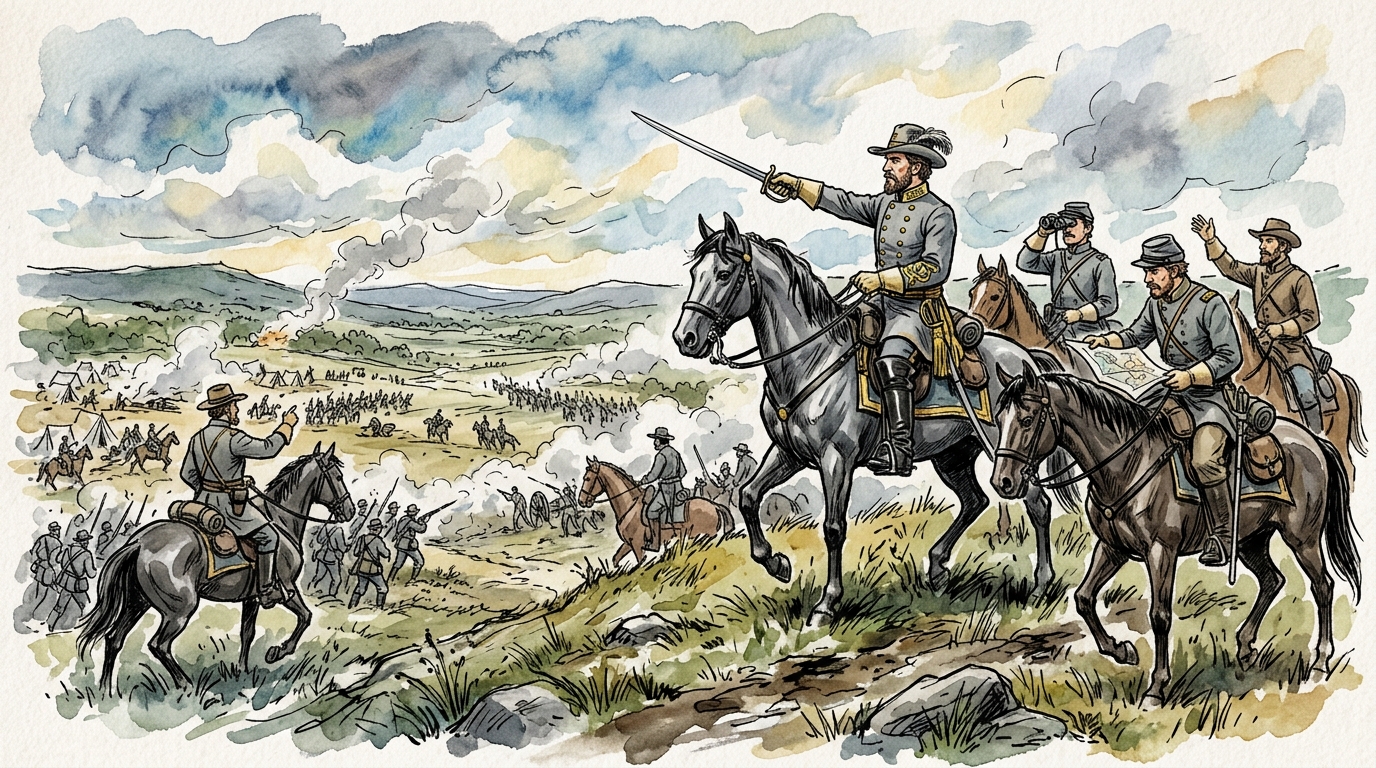
In historical Civil War combat, a brigade commander did not command from miles behind the lines; he stood immediately behind his regiments, often within shouting distance or a brief gallop by an aide-de-camp. The 12.0-inch Command Radius translates to approximately 300-360 yards at ground scale—the precise acoustic and visual limit through black powder smoke and wooded terrain.
By allowing free standard maneuvers for all units within this radius, the system reflects the professional competence of regimental colonels who knew how to maintain alignment and dress ranks without constant micro-management.
The Staff Pip mechanism captures the true bottleneck of 19th-century command: personal attention. A general could personally ride over to organize a bayonet assault, send staff officers galloping to hasten a reserve regiment forward at double-time, or personally rally a wavering line. But he could not do all of these things everywhere at once. Restricting pips to 1–3 per turn forces players to make the hard choice: Do I push the assault on the left, or keep a staff officer in reserve to refuse my threatened right flank?