Reactive Tactics
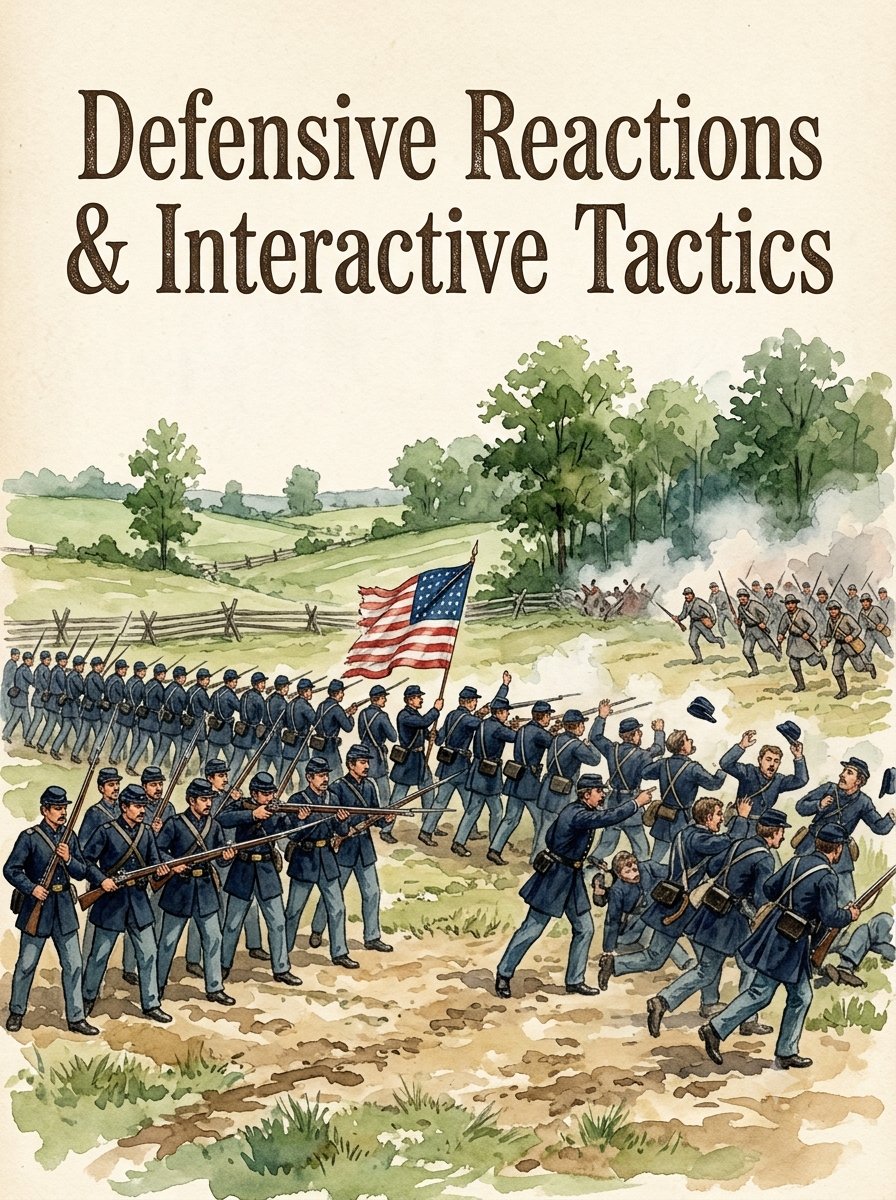
04. DEFENSIVE REACTIONS & INTERACTIVE TACTICS
"It is well that war is so terrible, or we should grow too fond of it." — General Robert E. Lee, 1862
1.0 The Reactive Philosophy & Trigger Windows
- [RULE-04-1.1] The Anti-Passivity Principle: In traditional side-by-side (IGOUGO) wargames, the non-active player often sits passively while their battle line is maneuvered around, flanked, or charged. This ruleset eliminates passive downtime by granting the defending player five specific, situational Tactical Reactions.
- [RULE-04-1.2] Reaction Trigger Windows: Reactions can only be declared during two distinct interruption windows in Phase 2: Active Maneuver & Assault Phase :
- Reaction Trigger Window A (Maneuver Interruption): Triggered during standard enemy movement when an active unit moves across a defender’s forward arc or closes within range of forward screens .
- Reaction Trigger Window B (Assault & Charge Interruption): Triggered when an active enemy unit declares a charge and closes to within 4.0 inches of a defending unit .
- [RULE-04-1.3] The Reaction Economy (Free vs. Reserved Staff Pips):
- Free Tactical Reactions: Reactions that reflect instinctive drill responses (Closing Defensive Volley and Skirmish Evade) require no Staff Pips and may be executed by any eligible unit in good order.
- Commanded Reactions: Reactions that require extraordinary tactical coordination (Refuse Flank and Counter-Charge) require the expenditure of 1 Reserved Staff Pip or a successful Discipline Check (4+ on 1D6) if no pips were reserved.
- [RULE-04-1.4] Single Reaction per Trigger Limit: A defending regiment or battery may only declare and execute one reaction per triggering enemy action. Once a reaction is resolved, the active player completes their movement or assault.
2.0 Reaction 1: Closing Defensive Volley (Point-Blank Charge Halting)
- [RULE-04-2.1] Trigger Condition: An active enemy unit declares an assault against a defending formed regiment or artillery battery and moves to within 4.0 inches of the defender's front edge.
- [RULE-04-2.2] Cost & Eligibility:
- Cost: Free (No Staff Pip required).
- Eligibility: The defending unit must have the charger in its forward 45^\circ arc of fire, must not be Disordered, and must not have an active Smoke Marker from prior firing.
- [RULE-04-2.3] Execution & Dice Pool:
- The charging unit's physical movement is temporarily halted at the 4.0" mark.
- The defender rolls its standard Phase 3 shooting dice pool (1D6 per stand firing; 2D6 per artillery section) using Short Range (0–6") to-hit numbers:
- Smoothbore Musket (Buck & Ball): Hits on 3+.
- Rifled Musket (Springfield/Enfield): Hits on 4+.
- 12-pdr Napoleon Canister: Hits on 2+ (Causes automatic Disorder).
- 3-inch / 10-pdr Rifle Canister: Hits on 3+.
- The charging attacker rolls saves for light/heavy cover if applicable (typically none in open ground charges).
- Apply stand losses (2 unsaved hits = 1 stand loss). Any natural 6 rolled to hit inflicts an immediate Disorder Marker on the charging unit.
- [RULE-04-2.4] The Charge Discipline Check:
- If the Closing Volley inflicts 1 or more stand losses OR inflicts a Disorder Marker, the charging unit's momentum is shattered and it must take an immediate Discipline Check on 1D6:
- Veteran / Elite: Passes on 3+.
- Regular: Passes on 4+.
- Green / Conscript: Passes on 5+.
- [RULE-04-2.5] Outcome of the Volley:
- Pass: The charging regiment steadies its ranks, absorbs the casualties, and closes the remaining 4.0" into physical base-to-base contact. Combat proceeds to Phase 4 Melee.
- Fail: The charge stalls. The charging unit immediately halts 2.0 inches away from the defender, receives a Disorder Marker (if not already disordered), and cannot move or attack further this turn.
- [RULE-04-2.6] Gunsmoke Aftermath: Place a Smoke Marker in front of the defending unit immediately after the volley is resolved.
3.0 Reaction 2: Opportunity / Interdiction Fire (Maneuver Punishment)
- [RULE-04-3.1] Trigger Condition: An active enemy unit executes a movement that crosses entirely within 8.0 inches across the forward 45^\circ arc of an unengaged defending formed regiment or artillery battery (e.g., executing a flank march, advancing in road column across a firing line, or moving between cover).
- [RULE-04-3.2] Cost & Eligibility:
- Cost: Free (No Staff Pip required).
- Eligibility: The defending unit must be unengaged in melee, must not be Disordered, and must not possess a Smoke Marker.
- [RULE-04-3.3] Execution & Resolution:
- The defending player calls "Opportunity Fire!" at the exact point in the enemy's movement path where the target enters optimal range and arc.
- The active unit's movement is paused mid-stride.
- The defender rolls 1D6 per stand using the appropriate range bracket (Short 0–6" or Medium 6–8").
- Target rolls cover saves if traversing light cover; apply casualties (2 hits = 1 stand) and mark Disorder on any natural 6.
- If the active unit is in Road Column, it suffers a -2 save penalty against Opportunity Fire .
- [RULE-04-3.4] Tactical Cost to Firer:
- Firing an Opportunity Volley places a Smoke Marker in front of the defending unit.
- Counts as Fired: The defending unit is marked as having fired; it cannot fire again during its own upcoming Phase 3 Ranged Combat Phase unless it spends its active turn moving out of its smoke.
- [RULE-04-3.5] Resumption of Movement: Once casualties and disorder are applied, the active unit resumes and completes any remaining movement allowance from the point of interruption. If the unit received a Disorder marker from a natural 6, its remaining movement distance is halved.
4.0 Reaction 3: Skirmisher & Light Cavalry Screen Evade
- [RULE-04-4.1] Trigger Condition: An active formed enemy battle line or column advances within 6.0 inches of, or declares an assault against, a detached Skirmish Stand or mounted light cavalry stand.
- [RULE-04-4.2] Cost & Eligibility:
- Cost: Free (Automatic drill maneuver).
- Eligibility: Any detached skirmish screen or mounted cavalry screen that is not pinned or disordered.
- [RULE-04-4.3] Evade Execution:
- The skirmish stand immediately executes a 4.0"–6.0" withdrawal move directly to the rear.
- Passage Exemption: The evading skirmish stand moves directly through friendly formed lines without causing a Passage of Lines test or disordering parent regiments.
- The skirmish stand is reintegrated into the parent regiment's rear rank or placed directly behind its Color Stand.
- [RULE-04-4.4] Attacker Redirection & The Overrun:
- If Evade is Chosen: The advancing or charging enemy unit does not stop; it continues its declared movement or charge directly toward the formed parent battle line positioned behind the vacated screen. The parent line may now execute Reaction 1: Closing Defensive Volley.
- If Evade is NOT Chosen (The Overrun): If the skirmish screen does not evade and is physically contacted by a charging formed unit (Infantry Line, Column, or Cavalry), the skirmishers are instantly Overrun and Destroyed (removed from play) without requiring a melee roll. The charging unit's momentum is not slowed; it continues its remaining charge distance directly into the target behind the skirmishers.
5.0 Reaction 4: Refuse the Flank (Hasty Pivot)
- [RULE-04-5.1] Trigger Condition: An active enemy unit moves or declares an assault that positions it within the Flank Zone (45^\circ–90^\circ) of a defending regiment in Line of Battle.
- [RULE-04-6.2] Cost & Execution Requirement:
- Cost with Reserved Pip: 1 Reserved Staff Pip . Automatic success.
- Emergency Check (No Pip Reserved): If no pip was reserved, the defending regiment must pass an immediate Discipline Check (4+ on 1D6). If passed, the maneuver succeeds. If failed, the regiment freezes in place, unable to refuse its flank, and receives a Disorder Marker.
- [RULE-04-6.3] Mechanical Execution:
- The defending regiment wheels its outer 1 or 2 flank stands backward up to 45^\circ to form an angled "L-shaped" defensive shoulder facing the incoming threat.
- The center Color Stand and opposite flank stands remain anchored in their original alignment.
- [RULE-04-6.4] Tactical Combat Impact:
- Negates Enfilade: Firing against the refused flank no longer counts as raking enfilade fire; the firer does not receive the +1 enfilade to-hit bonus .
- Converts Flank Assault to Frontal Contact: An incoming enemy charge targeting the refused flank must contact the newly angled stands frontally, denying the attacker the devastating +2 Flank Melee Modifier .
6.0 Reaction 5: Counter-Charge (Rebel Yell & Mounted Shock)
- [RULE-04-6.1] Trigger Condition: An active infantry or cavalry unit declares an assault against a defending unit across open ground within standard charge distance (9.0").
- [RULE-04-6.2] Eligibility & Traits:
- Any Confederate infantry regiment possessing the Rebel Yell trait .
- Any Veteran / Elite Union or Confederate infantry regiment in a Fresh health state.
- Any formed Mounted Cavalry regiment in good order.
- [RULE-04-6.3] Cost:
- Requires the expenditure of 1 Reserved Staff Pip . A unit cannot counter-charge without a reserved command pip.
- [RULE-04-6.4] Counter-Charge Surge Execution:
- Instead of standing stationary to receive the assault or firing a closing volley, the defending player shouts "Counter-Charge!"
- The defending unit surges forward 2.0"–3.0" into open ground to meet the oncoming attackers mid-field.
- [RULE-04-5.5] Melee Modifiers & Combat Impact:
- Negates Attacker Momentum: The original charging attacker loses its +1 Charging Momentum bonus and any downhill terrain bonuses.
- Shock Bonus: The counter-charging unit applies its +1 Rebel Yell or +1 Cavalry Shock bonus directly to the Opposed Melee Roll .
- Combat resolves immediately in Phase 4 Melee as an open-field clash.
7.0 Master Summary Matrix of All 5 Reactions
| Reaction Name | Primary Trigger | Staff Pip Cost | Eligible Units | Mechanical & Combat Effect |
|---|---|---|---|---|
| 1. Closing Volley | Enemy charges within 4.0" | Free | Formed unsmoked, undisordered units | Point-blank volley; 1+ hit or Nat 6 forces charger Discipline Check (4+) or charge stalls 2.0" away Disordered. |
| 2. Opportunity Fire | Enemy crosses front arc within 8.0" | Free | Unengaged, unsmoked formed lines | Pauses enemy move; delivers volley; places Smoke Marker on firer; counts as fired for next turn. |
| 3. Skirmish Evade | Formed enemy closes within 6.0" | Free | Detached skirmishers / cavalry screens | Screen makes immediate 4"–6" escape move through friendly lines without disordering parent unit. |
| 4. Refuse Flank | Enemy enters flank zone (45^\circ–90^\circ) | 1 Reserved Pip (or 4+ Check) | Formed infantry lines in Line of Battle | Outer 1–2 stands wheel 45^\circ to face threat; cancels enemy +1 enfilade to-hit and +2 flank melee bonuses. |
| 5. Counter-Charge | Enemy declares charge in open ground | 1 Reserved Pip | Rebel Yell units, Veterans, or Cavalry | Unit surges 2"–3" forward to meet attacker; cancels attacker momentum; applies +1 shock trait. |
-
Assault Declaration: The 14th Brooklyn declares a charge against the 5th Virginia across an open pasture (8.0" separation). The Union player spends 1 Staff Pip and moves the Brooklyn regiment forward.
-
Interruption at 4.0 Inches : At the 4.0" mark, movement halts. The Confederate player declares Reaction 1: Closing Defensive Volley.
-
Volley Execution :
-
The 5th Virginia fields 5 stands armed with Smoothbore Muskets (Buck & Ball). At Short Range (0–6"), they hit on 3+.
- Dice Pool: 5D6. Rolls:
[3, 3, 5, 2, 6]. - Result: 4 hits scored (including one natural 6).
- Casualties: 4 hits = 2 physical stands removed from the 14th Brooklyn.
-
Suppression: The natural 6 inflicts an immediate Disorder Marker.
-
Discipline Check :
-
Sufferings stand losses and Disorder forces the 14th Brooklyn to make an immediate Discipline Check (4+ for Regulars).
-
The Union player rolls a
2—Failed! -
Aftermath : The charge stalls. The 14th Brooklyn halts 2.0" away from the Virginia line, reduced to 3 stands, Disordered. The 5th Virginia receives a Smoke Marker. No melee occurs.
9.0 Designer Commentary & Historical Context
Why These Five Reactions?
The historical record of the American Civil War is replete with moments where a battle turned on split-second regimental reactions rather than high-level generalship: * The Closing Volley: At the Battle of Franklin (1864) and the Peach Orchard at Shiloh (1862), advancing assault waves were repeatedly shattered and halted within 30 paces by disciplined, point-blank volleys delivered by steady defenders waiting behind breastworks. * Refusing the Flank: Joshua Lawrence Chamberlain’s famous maneuver with the 20th Maine at Little Round Top—wheeling his left-flank company back at a right angle—is the quintessential example of Refusing the Flank under pressure. * The Counter-Charge: Confederate doctrine frequently emphasized meeting an oncoming Union advance with a sudden, screaming counter-charge into open ground, catching the Federal line disordered as it crossed fences or ditches.
By codifying these historical behaviors into five clear reaction triggers governed by a simple resource economy (Reserved Staff Pips), the game achieves maximum tactical realism and high player engagement without degenerating into chaotic, off-turn rule arguments.